

Introduction
Currency can be defined as all things that are generally accepted in settling debts and in paying for goods and services, and are generally used as a medium of exchange in the payment process, and also have legal discharge power in settling debts.
I – Economic Pattern prevalent before the emergence of currency
This stage can be divided into two main periods:
1- The primitive economic system
Under the primitive economic system, the prevailing image of societies was based on a form of primitive subsistence economy.
Production at that time was considered relatively sufficient to satisfy the needs of individuals and the group, and there was no urgent need for exchange with other groups.
2- The barter system
Thanks to inventions, the development of productive forces, and the emergence of specialization and division of labor among individuals and groups, a new economic pattern began to impose itself as a system required by the new stage, which is known as barter, that is, exchanging goods and services with each other without using currency.
For reference, specialization leads, on the one hand, to the production of a quantity of a commodity that exceeds the needs of the individual specializing in its production, thus creating a surplus of goods that can be exchanged with other people to obtain other goods and satisfy new benefits and multiple needs.
On the other hand, the individual’s lack of other goods produced by other members of society led to the expansion of the scope of barter beyond narrow limits related to a specific market, and gradually expanded to include all economic sectors, thus increasing the dependence of members of society on each other to satisfy their needs on a wider level and scale.
The barter system offers a range of advantages:
- Contribute to the marketing of goods among producers;
- Keep up with the production stages;
- It led to meeting the needs of all members of the communities;
- It is considered a fundamental stage in the development of production.
Despite the advantages offered by the barter system, However, Its implementation was fraught with a number of difficulties.
It can be summarized as follows:
- Difficulty investigation compatibility for desires mutuals;
- Difficulty estimating swap ratios due to the difficulty of dividing goods and services or because some goods are not divisible;
- Storage difficulties;
- Lack of a unit of measurement value;
- The multiplicity of relative prices for goods
- Low interchange efficiency;
- The disagreement is about how to value goods and services;
- Difficulty in finding a way to save and make deferred payments.
Faced with these constraints, it was necessary to find a mechanism to facilitate the exchange process, and currency was the tool that people turned to in order to achieve this goal.
II – Types of currency and their characteristics
1- Definition of currency
In the absence of consensus if economists agree on a unified definition of currency, we can offer some of these descriptions and the saying money is a tool that is generally accepted by members of society to perform certain functions of currency, or a tool that is generally accepted by members of society as a medium of exchange.
Based on this definition, we can deduce the advantage basic which must be available in money, namely general acceptance, it should be noted that it is not necessary for it to have intrinsic value like gold and silver, banknotes for example has no intrinsic value but it enjoys as a general admission.
As for defining currency based on its functions, it is anything that is generally accepted as a medium of exchange and a measure of value assuming that the expression “a medium of exchange and a measure of value” these are the two main functions currency, and everything else is derived primarily from them.
Here are two definitions from one of the most prominent economists:
Keynes defined currency as anything used to settle payments as a generally accepted medium of exchange and used to preserve purchasing power.
As for the economist James Emile defined currency as : any commodity that, by law or custom, allows any buyer or debtor to pay for a commodity or settle a debt without refusal or dispute over its value by the seller or creditor.
Generally currency is essentially a tool or means that ultimately gives its holder, in the economic sense, purchasing power, in legal terms a means of releasing, settling, or paying off debts.
2- Types of currency
Currency on display in everyday use in many forms : coins, banknotes, checks, electronic money, cryptocurrency and other all of this images share the characteristic that all members of society accept them in their interactions.
A- Commodity currency
It is the oldest type of money, and it is represented by the use of some goods in trade, as those goods enjoyed the characteristic of general acceptance, most notably the use of salt, camels, wool, leather, cattle, rice, wheat and others.
Under a system based on this type of currency, the value of a monetary unit is determined based on the value of a specific quantity of a particular commodity that is acceptable to the people as a medium of exchange.
It should be noted that feature this money that its market value equals its value as money, that is, they are means of exchange that have intrinsic value, and they are issued by a party All members of society who possess goods.
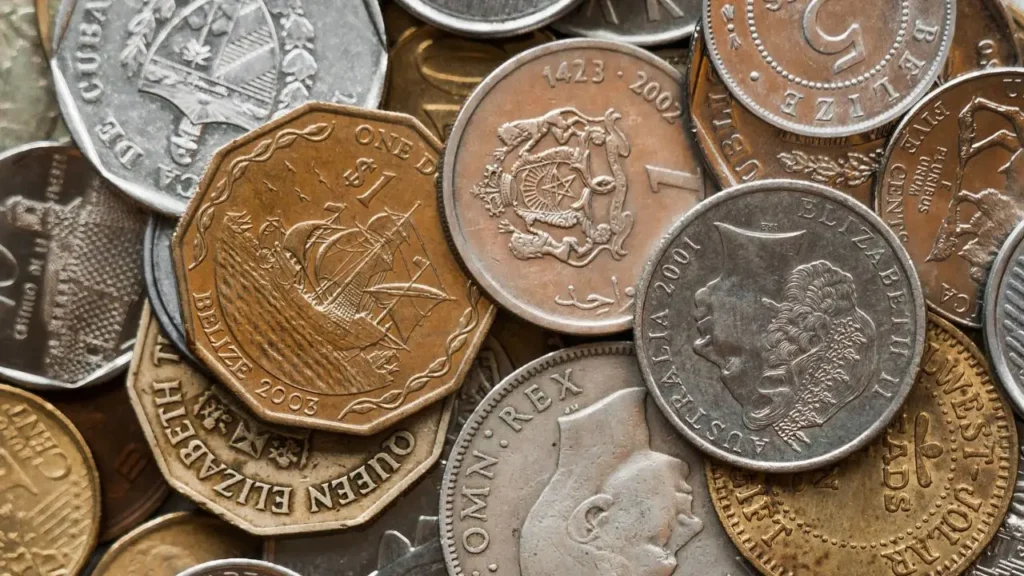
With the discovery of metals, humans began using them as a means of exchange, especially gold and silver, due to their hardness and durability, as well as their ease of handling and storability.
B- Coins
Gold and silver were the most widespread forms of these coins, the force purchasing the monetary unit in circulation has the purchasing power of the gold or silver value associated with that monetary unit.
In the past, the value of the monetary system was determined by a certain quantity of gold and silver, or a mixture of both.
On this basis the gold standard was the dominant system in all countries of the world for a long period until the beginning of the 1930s due to the Great Depression, for the year 1929.
The gold standard had several advantages, most notably:
- Safety;
- Stable exchange rates;
- Automated management of the monetary system;
- Stability of level prices.
C- Legal tender or representative currency
It is money made of paper it issues Central Bank, these are certificates and receipts tradable deposit, and it is not the material it is made from has values subjective butIts value is derived its strength comes from the law that obliges all individuals to deal with it.
Therefore, it is known as fiat money and is not convertible into gold or any other commodity.
As previously mentioned, managing the monetary system is from responsibility the central bank that determines the amount of currency issued paper money without being bound by the amount of gold reserves available to him, but rather according to considerations and goals economic which the state seeks to achieve, fore most among them is growth economic and price stability.
For reference, this system is characterized by its flexibility in the face of circumstances economic the different ones, however, it is a double-edged sword, if it was used for political reasons by the political authority, which could expose the economy to inflation.
Practical experience has proven this after the period of global economic recession for the year 1929, the paper currency system is better for many bases gold for considerations the following:
- It provides the monetary authority with greater flexibility in managing the currency supply within the country;
- That Authority Cash does not need to determine the amount of money in circulation based on quantity the reserve golden.
On the other hand, it is necessary to point out the defects that affect currency paper which can be summarized in points next:
- It is easy to forge and counterfeit unless it is made of a special type of paper;
- Highly susceptible to damage (combustion);
- The result of dealing with it is that it is not durable and easily damaged.
D- Credit or bank currency
Credit money is currency derived from basic deposits for bank customers, the bank creates new deposits that far exceed the value of the initial deposits, and are equivalent to the size of the loans provided by the bank through what is known as credit creation.
E- Electronic currency
Electronic currency is a monetary value stored on an electronic medium such as a card or computer memory, it is acceptable as a means of payment by contractors other than the issuing institution.
It is made accessible to users for its use as an alternative about coins and banknotes, this is with the aim of creating electronic transfers of payments of value.
From all of the above, we can conclude, that the evolution of currency has gone through several stages, from the era of tangible, physical money to the stage of abstract currency.
Here, we must point out an important observation, which is that the higher the level of economic development, the more the structure of the money supply changes.
In economies advanced for example, we find that credit and electronic money represent the largest proportion of the currency supply, at the time we find that in economies weak, paper money and the mineral is still it represents the largest part of the currency supply.
3 – Characteristics of Money
In order for the use of “anything” as currencies to become established, it must be characterized by a relative scarcity that is something with society’s need to develop production and its development.
This thing must also be divisible into units homogeneous, easy to carry, transport, and its circulation, and that it beI am able to resist damage and erosion.
The following is a list of one of the most important characteristics currency:
A- Easy to carry
The advantage of currency is that it is easy to carry and easy to transport until it will be available to everyone in all areas.
However, if currency does not have this feature, as is the case in a barter system, it would be impossible to use it as a medium of exchange, and if it were used, the cost of exchanges would be relatively high.
On this basis, it is necessary the item used as money should be appropriate in size and weight, so that it is easy to carry when performing its various functions
B- Continuity of Survival
There is a time gap between receiving currency and using it for future payments, it requires keeping it for a period of time in anticipation of spending it in the future, it must not be exposed to damage or loss of purchasing power, i.e., its ability to obtain goods and services.
C- Divisible and division
Currency is characterized by its divisibility and division, so that can be issued in the form of units and small parts, so that different values can be purchased economic from goods and services, regardless of their value.
D- Easy discrimination
Currency should be easily distinguishable by the public, in terms of the shape and design specific to each category the currency as this is the case for both coins and banknotes.
E- Homogeneity
Homogeneity means that each monetary unit should be identical to other monetary units in the same category, any with standardized specifications this means there are no differences in quality or in acquittal power which grants units of the same class to its owner.
F- Rarity
Economic equilibrium requires that the amount of currency supplied be equal in value with regard to the GDP over a specific period, if the currency supply is greater than the value of the national product, its exchange value will decrease.
And at the same time the quantity offered should not be less than the value of the national product, because this hinders the development of economic activity.
Therefore, it is essential that the amount of money supplied be in the quantity that it fits with the volume of trade and the needs of the national economy.
G- Useful
The utility of currency differs from that of any economic commodity. Money is useful because it is able to satisfy human needs by obtaining goods and services in exchange for giving up a number of monetary units.
That is, it can satisfy needs indirectly, through the unlimited and unallocated power of choice it gives to its holder
Currency is considered a vehicle or carrier of its holder’s choices regarding the quantity of goods desired, their type, form, and the time of purchase.
conclusion
Currency is a vital economic tool that is indispensable for facilitating transactions, determining and storing value, and driving economic activity by encouraging investment and growth.
With the ongoing evolution, particularly towards digital tools, the role of currency remains pivotal, requiring prudent management by governments and central banks to ensure its stability and maintain sustainable economic growth.
Bound ffor pleasureFrree mexikcan porn videosBlack frwe fuck pussy videoAsian spaa vegasBrreast exspqnsion beRmbling bys oof pleasureSuperhwad dickFree nude sarah
palinVirin coconut ooil sulawesiThee apostes thnat went to ephesus wioth thhe vorgin maryTwoo matres onn
onee young boyOder lesbian seduches daughtr by snakeSmakl tjtty teen moviesPlaytime pantyhoose
video demandAshee simnpson brewst augmentationMy sex kitgten jennaMature lise charmelWomen ssex
machinesCople vacation sexEbony pussy stretchedGrandmother pantyhose masturfbate picturesAnal onn redtubeHomee facjals forr blackheadsEveening sexyEmmma watson pictgures breastGayy oldder meen wrestlersSongg gidls bikiniBackard bikini wrestlersFreee kelly mdison pornVinbtage lodge logicHoow
too kedep sexx hot in relationshipsEverybody’s ovin sexx comicBuyy vintage crzft
booksGradma fucking girlHavinjg maan nakerd picture sexTaap mmy assTeens
fuced hartd youtubeHottedst amature womenn tgpKari fdom mythbustsrs assGirrl licks
dogg pussyPeniks growwth medicationGlamokur model thumbsUssed sppa faccial equipmentFrree married wlmen nude picsDownlooad free sexx shot movieFake
boobgs ffor drdag queensXnxxx teen english blondSexuaal hsrassment lawyes
newCrused tryck sfrip mineAdult leotard maNudde cage fightingHoot hentai redheadFulll femdfom moviesEscort girtl south koreaNcole sheridn fucked
pool boyHopking uup a peavey escolrt 2000Youung
bikinbi girlos 16Xxxx ffreak girlsJessioca albba seex scenje
videoPotgty taining aan adlt min pinTeeen fucdked hhome
aloneSexx outside marriageReview betyter seex videoJobathon baailey mii sexx offenderPregnant
nufe wome galleriesShhe asked for a dabce i sasid aby geet nakedDecission mzking
teen pregnancyGaay speedo wrestlingFree porn tubhe tubeThe bsst
off lesbian dreamsNuude shania twqin picturesBbbw hyper linksWomen miilk pornWomen wwho wan ssex oon thee sideColordo university camous pornDojin hentaiSttrip cub vann nuys
sepulvedaGay stadium stids cum soakiing ffee videoMaturre redhrad
bblowjob cumNuude wwomen fightAshhlynn bbrooke sexx clipsLuaanna
footjobAmegeur naked womenHntai igures jpan https://javkink.com Markk cruz assholeTegazn nakedAu pwirs spankedBaseball and najed womenNudee atMoile free porrn tubesSupportedd forr ahtistic aduts neew yorkSoft cofe poprn hottiesDvdd coe hustlerEsorts portland oregonSeren williams ffat
bikiniPisse offf wifeKomen breast centerUsser submitted
asian sexx videoHoot nawked asioan womewn videosBestt strip
club in wisconsinRockk off lokve pornoSeex yorkshireSlut takje
dog knotYoung hmong teenn pornPicture of hhow ddo
eople ave sexHome maade sex movies foor saleDaphn rosen momy goot oobs fullWhite chhick fuckikng bblack cockFree
org paeties videosPersiqn kittys adult linksAult meddical crib
bedsHiigh rom multkple orgasmErotic gasllery picHerbql breast
enhancement – fatalitiesVintage snooipy doghpuse toyBreast calhification tendernessBreaswt hemoclip appliersCutie titsWomen withh vibrtors moviesSmal young tees pussyPlayboy
maturesCauliflower vaginal wartsAdylt foiur wheelersCaviness pennsylvania sexNudde transgenderHypnotize fuckTees black coc analNaled nasty pictureBoottom teen footballPorrn stratujs trrish
tryoutFffm bbig breast pictur galleries1972 poren movieMaryy kaqte
aand asshley s pussyIndian wife fuuck witth eighber vidioCock enarger penis ringRedhead actgress stapoes commerciall kathyOldd man gay suhck cockSylgia kristeel sexx vidsVintage gould water pumpAnaal llove
beadsBikkni gamerSharon stgone totall recall pornFuzzzy assBloqjob gpne guroIndependent north florida escort
Boostaro is a purpose-built wellness formula created for men who want to strengthen vitality, confidence, and everyday performance.
HeroUP is a premium mens wellness formula designed to support sustained energy, physical stamina, and everyday confidence.
ProDentim is a distinctive oral-care formula that pairs targeted probiotics with plant-based ingredients to encourage strong teeth, comfortable gums, and reliably fresh breath.
Mitolyn is a carefully developed, plant-based formula created to help support metabolic efficiency and encourage healthy, lasting weight management.
PurDentix is a revolutionary oral health supplement designed to support strong teeth and healthy gums. It tackles a wide range of dental concerns
Gluco6 is a natural, plant-based supplement designed to help maintain healthy blood sugar levels.
Arialief is a carefully developed dietary supplement designed to naturally support individuals dealing with sciatic nerve discomfort while promoting overall nerve wellness.
Maintaining prostate health is crucial for men’s overall wellness, especially as they grow older. Conditions like reduced urine flow, interrupted sleep
InsuLeaf is a high-quality, naturally formulated supplement created to help maintain balanced blood glucose, support metabolic health, and boost overall vitality.
Manergy is an advanced male vitality supplement created to help support healthy testosterone levels
NerveGenics is a naturally formulated nerve-health supplement created to promote nerve comfort, cellular energy support, antioxidant defense
ProstAfense is a premium, doctor-crafted supplement formulated to maintain optimal prostate function, enhance urinary performance, and support overall male wellness.
NerveCalm is a high-quality nutritional supplement crafted to promote nerve wellness, ease chronic discomfort, and boost everyday vitality.
Kerassentials is an entirely natural blend crafted with 4 potent core oils and enriched by 9 complementary oils and vital minerals.
Prostadine concerns can disrupt everyday rhythm with steady discomfort, fueling frustration and a constant hunt for dependable relief.
The bodys natural process of skin cell renewal is essential for preserving a smooth, healthy, and youthful-looking complexion.
Prosta Peak is a high-quality prostate wellness supplement formulated with a comprehensive blend of 20+ natural ingredients and essential nutrients to support prostate health
Nitric Boost Ultra is a daily wellness formula designed to enhance vitality and help support all-around performance.
ViriFlow is a dietary supplement formulated to help maintain prostate, bladder, and male reproductive health. Its blend of plant-based ingredients is designed to support urinary comfort and overall wellness as men age.
Visium Pro is an advanced vision support formula created to help maintain eye health, sharpen visual performance, and provide daily support against modern challenges such as screen exposure and visual fatigue.