Introduction
Maritime straits are the gateways to major maritime routes, and they also constitute transverse passage points, which allow the territory on the other side to be connected or, on the contrary, isolated.
Thus, navigation, both civil and military, is heavily constrained by a series of major international straits and canals that define the major maritime routes : these are obligatory passage points.
Their control, security and proper functioning represent major geoeconomic, geopolitical and geostrategic challenges because they constitute potential bottlenecks.
I – What is a maritime strait ?
1 – Definition and characteristics of a strait
Straits are arms of the sea more or less longs and tighteneds between the two coasts whichs border, surrounded by land, and which connect two maritime spaces.
They constitute both a separation and a bringing together, these are links between these maritime spaces and the lands that border them in these specific places, if they are relatively narrow.
But, because they are also obligatory passage points, they concentrate local and transit flows, and constitute sensitive links in maritime routes, easy to close or whose navigational safety can be compromised.
2 – Difference between a strait, a canal, and a sea passage
Sea routes, canals, and straits are essential transit points for the flow of goods traded worldwide. They organize global trade, connect major economic centers and concentrate security concerns. But they do not all have the same function or the same impact.
Maritime routes follow well-defined axes between major production and consumption centers, linking major economic regions. They are organized around dynamic coastlines and specialized ports.
It should be noted that canals are artificial, while straits are natural. Moreover, the fundamental difference lies in the origin of the passage. Thus, a strait is a narrow maritime passage formed naturally by the separation of two landmasses, while a canal is a navigable waterway dug by humans to connect two bodies of water.
3 – Why are straits strategic ?
Straits, veritable ocean gateways, remain major issues for trade and migration flows, as well as for security and the deployment of naval strategies.
Control of these straits allows states to exert political and economic pressure in times of crisis. During a political, economic, or military crisis, states can threaten to close or restrict access to the strait or canal they control. This directly results in a significant decrease in global supplies.
In this context, the recent closure of the Strait of Hormuz and its repercussions on energy markets have served as a reminder of how much the global economy depends on a few strategic maritime passages, given that more than 80% of international trade transits by sea, and a disruption of one of these “bottlenecks” can cause immediate consequences on a planetary scale.
Besides, according to the forecasts of WTO economists Global trade is expected to slow down in 2026, and the conflict in the Middle East could darken the outlook by raising energy prices and disrupting trade flows.
It is true that, alternative options exist, but they will be more expensive since’they will’move away from an economic optimum and lead to an increase in cost.
II – Why are straits essential to world trade ?
1 – A concentration of international trade flows
Catalysts for the globalization process, reinforced by the progressive liberalization of markets,
The constant intensification of flows and the facilitation of trade, reinforced by the progressive liberalization of markets following the globalization process, have rapidly led to a significant increase in the use of maritime transport.
With over 80% of the world’s traded goods transiting by sea, the most important straits and canals have becomean essential hub for global supply and strategic and coveted spaces where any disruption will have cascading effects.
In 2022, approximately 70% of the volume of goods transported by sea consisted of raw materials, 40% of which is attributable solely to hydrocarbons.
Whether energy, metal or agricultural, the dependence of modern economies on these raw materials therefore gives maritime transport the primary role of global supply vector.
This is why maritime routes remain at the heart of government concerns and calculations : maritime transport structures the global economy.
2 – Reduction of distances and logistical costs
Natural passages and artificial canals make it possible to avoid long circumnavigations of continents, thereby reducing maritime distances, which translates into several economic advantages :
Fuel savings : Shorter distances mean lower fuel consumption, which reduces the variable cost per container.
Fleet optimization : Shorter routes allow ships to make more trips per year. This maximizes the profitability of huge container ships and reduces the need to invest in additional vessels.
Delivery times : Crucial for “just-in-time” supply chains, this reduces inventory storage and holding costs.
III – The main sea straits of the world
On an international scale, there are 28 world-class passages, 7 of which are major :
– 5 straits the most frequented ones are :
- Malacca ;
- Ormuz ;
- Bab-el-Mandeb ;
- Gibraltar ;
- Bosphore & Dardanelles.
– 2 channels who are :
- Suez ;
- Panama.
– And that makes 2 caps :
- Good Hope ;
- Magellan.
It should be noted that traffic separation systems, designed to limit the risk of collision, govern maritime traffic in the straits.
Below are the five main straits :
1 – The Strait of Malacca : Asia’s trade artery
The 800 km long Strait of Malacca is one of the world’s major ocean gateways, the second largest port in the world and a maritime hub for all of Southeast Asia. It is the key interface between the Pacific and Indian Oceans.
It should be noted that the importance of the Strait of Malacca therefore gives it a particular strategic character. It is considered an international maritime route, despite the proximity of the coasts of the bordering states namely Indonesia and Malaysia.
2 – The Strait of Hormuz : a vital passage for oil
Hormuz is one of the bottlenecks where global maritime traffic is concentrated. It is off the coast of Iran, and is a key passage through which approximately 20% of seaborne oil, as well as 25% of gas and a significant portion of fertilizers transit.
Its importance was recently demonstrated during the war against Iran, during which the blockade of the Strait of Hormuz completely disrupted world trade.
3 – The Bab el-Mandeb Strait : Gateway between Europe and Asia
The Bab el-Mandeb Strait, between the Red Sea and the Indian Ocean, is a strategic passage in a globalized economy heavily reliant on maritime transport. It lies on the major Asia-Europe route via the Suez Canal.
It is a strategic maritime stronghold located in an area of instability due to maritime piracy, the existence of fragile states such as Eritrea and Djibouti, and the civil war in Yemen.
4 – The Strait of Gibraltar : crossroads between the Atlantic and the Mediterranean
The Strait of Gibraltar is the only natural link between the Atlantic Ocean and the Mediterranean Sea and one of the busiest waterways in the world.
Indeed, approximately 300 ships cross the strait in 24 hours, or one ship every 5 minutes.
It is a major intercontinental and interoceanic passage, measuring approximately 60 kilometers long and between 14 and 44 kilometers wide. It is located south of Spain, north of Morocco, east of the Atlantic Ocean, and west of the Mediterranean.
It therefore functions simultaneously as a gateway, a lock, and an interface of exceptional quality. It thus constitutes a major geostrategic issue at continental and global levels.
Its control and the security of navigation and multifaceted trade flows explain the intense geopolitical rivalries, symbolized in particular by the presence of the enclaves of Gibraltar and Ceuta.
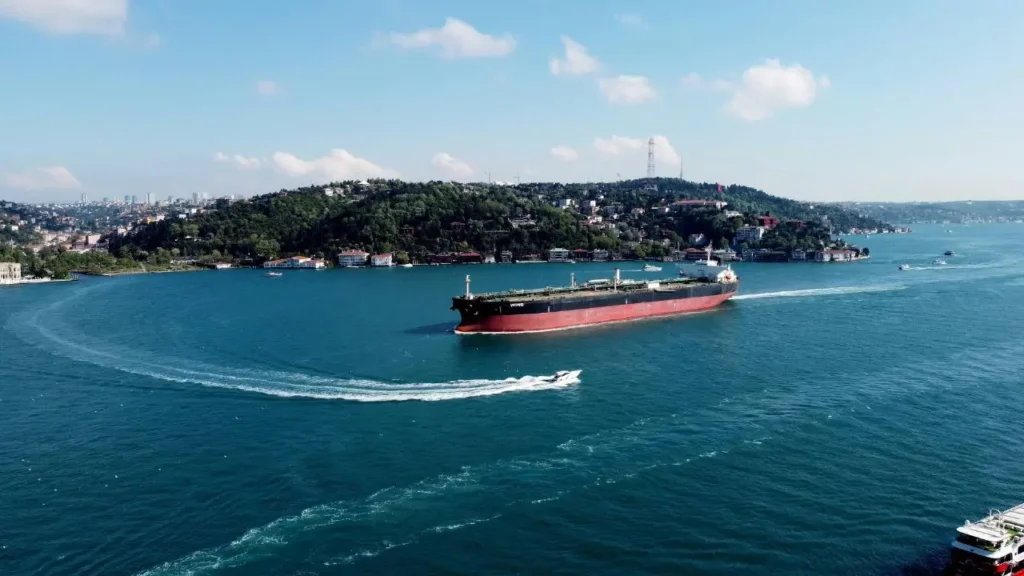
5 – The Turkish Straits (Bosphorus and Dardanelles)
The Turkish straits are two narrow arms of the sea on either side of the Sea of Marmara. To the south, the Dardanelles extend from the Aegean Sea to the Sea of Marmara for a length of 78 km and a width of 1350 to 8275 meters;
To the north, the Bosphorus Strait, 30 km long and 700 meters wide, connects the Sea of Marmara to the Black Sea.
The Dardanelles and the Bosphorus have been the subject of constant conflict and rivalry throughout history.
Moreover, their pivotal position between Asia and Europe on the one hand, the Black Sea and the Mediterranean on the other, and above all their function as a transit point, has always made them a major strategic zone.
IV – The geopolitical stakes of maritime straits
1 – Strategic control and sovereignty of states
Changes in the international geopolitical order have profound impacts on the strategic importance of straits, altering their geopolitical environment, or leading riparian states to reformulate their strategy at this point of passage.
The global economy remains dependent on maritime trade because the economies of various countries have seen the share of their GDP increasingly dependent on their sales in distant markets.
This explosion in maritime traffic, particularly in certain extremely active straits, raises the question of navigational safety.
These globalized straits present challenges for both regional actors and more distant powers, sometimes for different reasons.
2 – Risks of international tensions and conflicts
The blockade of the Strait of Hormuz underscores the importance of strategic maritime passages, given that over 80% of the world’s traded goods transit by sea.
Some of these bottlenecks are particularly sensitive due to their geographical location and their vulnerability to incidents or conflicts.
Actually, these maritime zones represent major weaknesses for international trade in the event of geopolitical tensions.
In the event of war, the global economy is under pressure and the economic repercussions are already visible : rising energy prices, increased risks of inflation, and extremely volatile financial markets.
Conclusion
Straits therefore represent major geopolitical issues in a globalized economy, and behind each of these crossings lies a major strategic issue : their control can influence energy prices, supply chains and sometimes even the global geopolitical balance.
1 thought on “Maritime straits : why are they essential to global trade?”