
Introduction
In principle, like any other commodity, fluctuations in oil prices have been a key driver of global macroeconomic trends for several decades.
Thus, oil shocks significantly influence economies, particularly those heavily dependent on energy imports, insofar as price volatility reacts to fluctuations in supply and demand.
This volatility in oil prices affects the cost of energy inputs, increases production costs and consequently reduces the economy’s capacity to distribute wealth, and, therefore, the growth of importing countries.
Furthermore, oil price fluctuations alter the terms of trade and lead to income transfers from importing countries to exporting countries.
Overall, these fluctuations exert substantial pressure on public finances, the trade balance and inflation in dependent economies.
In any case, fluctuations in oil prices are transmitted to the economy through several macroeconomic channels. They notably influence :
- Production costs;
- External competitiveness;
- Investment and consumption patterns;
- Fiscal and monetary policies.
I- Impact on the global economy
Changes in oil prices impacting the global economy by causing inflation and slowing growth (GDP) for importers, and increasing revenues for exporters.
An increase in the price of a barrel of oil raises production and transport costs, reducing household purchasing power and business margins.
1- Economic growth
In fact, for importing countries, rising oil prices tend to reduce the real disposable income of economic agents, which can dampen domestic demand and negatively affect economic growth.
So, it has an opposite effect on external demand since it increases the income of OPEC countries and thus promotes their exports.
Thus, the international transfer of wealth represented by the payment of the oil bill has beneficial effects for OPEC countries which have benefited from financial surpluses which they have alternatively invested, through sovereign wealth funds, or kept in the form of foreign exchange reserves, thus contributing to global liquidity and the maintenance of low interest rates.
On the other hand, rising crude oil prices lead to a slowdown in growth, which translates into a decrease in household consumption, resulting in a reduction in business production.
This slowdown leads to increased unemployment and, consequently, a further decline in purchasing power, and so on. These periods of oil crisis can therefore trigger periods of recession during which a country’s GDP (Gross Domestic Product) slows its growth or even declines.
Generally, the rise in the price of oil results in :
- An increase in the cost of intermediate consumption followed by a slowdown in production and productivity;
- A decline in consumption of durable goods and investment, as the economic environment becomes uncertain;
- An increase in production costs and a reduction in the economy’s capacity to create, or more precisely, to distribute wealth;
- Inflationary pressure likely to slow growth.
2- Inflation
The rise in fuel prices is primarily a supply shock. It acts as a major driver of inflation, due to the omnipresence of petroleum products in the economy, directly increasing transportation, logistics, and production costs.
This surge quickly spreads throughout the economy, impacting the price of consumer goods and consequently affecting household purchasing power.
In this context, faced with rising costs related to fuel expenses, companies have several solutions :
- Reducing their profit margin, at the risk of jeopardizing their business;
- Make their customers pay for the fuel price increase by raising the prices of products, services or delivery;
- Finding a compromise by making the increase in fuel costs impact both their profits and their customers.
Generally speaking, it is the end customer who pays, in whole or in part, for the additional costs associated with rising gasoline and diesel prices. This is why increased energy costs can lead to widespread and sustained inflation.
II- Impact on consumers
1- Fuel prices
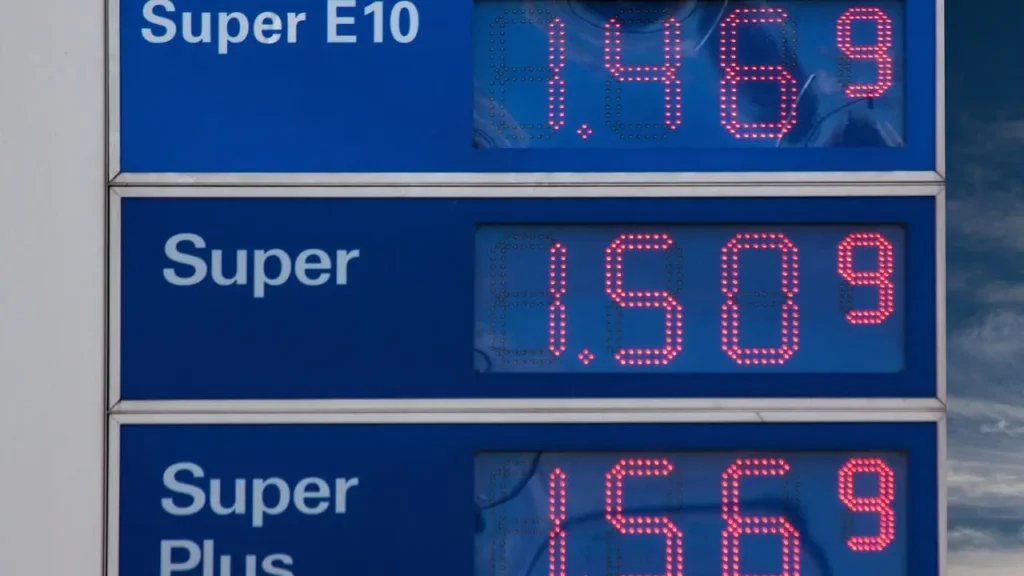
In principle, fuel prices follow the rise in the price of oil, which translates into an increase regarding prices at the pump, this transmission is always partial and delayed, which means in concrete terms that the consumer is only just beginning to feel the effects of this surge in the price of a barrel of oil over time.
Thus, the increased cost of fuel oil and other fuels reduces household purchasing power, as users making daily commutes would see their monthly expenses increase.
Furthermore, it should not be forgotten that the price of gasoline does not depend solely on the price of a barrel of crude oil, since taxes, exchange rates, and refining and distribution costs also influence the price of fuel.
Indeed, several factors contribute to this increase:
A- The refiners
When the price of oil rises, gasoline prices tend to rise as well. This is due to the production chain: gasoline is derived from refined petroleum, so its cost depends on the price of crude oil.
B- Carriers and the distributors
Faced with the blockage of maritime routes, carriers must find alternative, longer, and more expensive routes. These additional costs ultimately impact the final price.
C- The State
On every litre of petrol, paid for at the pump, a percentage goes directly to the State coffers in the form of taxes, via fuel excise and VAT.
2- Cost of living
An increase in transport costs would inevitably lead to a rise in the prices of basic necessities, thus directly impacting the average household’s budget.
For this reason, an oil shock tends, from the moment of its impact, to reduce real wages for the simple reason that nominal wages are often fixed for one year, while the increase in the price of oil reduces purchasing power and is quickly passed on to other prices.
Furthermore, household energy expenditures can therefore be described as regressive in the sense that they disproportionately affect low-income households. These households are thus particularly affected by rising oil prices.
To mitigate the increase somewhat, the state could temporarily lower its taxes to provide relief to consumers. Since it can subsidize private entities to help them cope with rising oil prices and accept a decline in its own revenues in order to preserve those of private entities.
Obviously, this would have a cost for public finances.
III- Environmental Impact
1- Energy transition
The economic shift towards greener growth will be a long process requiring significant private and public investment. This is because changing energy sources is not easy, and reversing them is difficult.
Thus, the process of developing a new economy based on green growth, which will be more energy-efficient and less dependent on fossil fuels, and whose main axes are :
- Improving energy efficiency through :
– The adoption of new heating methods and the use of insulation in the building sector;
– The reduction of fuel consumption, electric vehicles, development of rail transport in the transport sector.
- The development of renewable energies, in particular wind, photovoltaic and hydroelectric power;
- Investment to develop new production processes that have become more profitable due to rising energy prices;
- Redeployment towards less energy-intensive production;
- Research support: in order to advance the carbon sequestration strategy.
2- Investments in renewable energies
In principle, the goal of investment in renewable energies is to substitute other energy sources for oil.
The aim is, in effect, to green the production methods of existing companies and to promote the emergence of new green sectors dedicated to environmental protection activities.
Moreover, these developments require significant research efforts and investments to design and develop new technologies.
Therefore, government intervention to support this green growth program is justified on several levels.
The government intervenes to promote climate and environmental gains by compensating economic actors for avoided emissions and, more generally, for the environmental protection actions they undertake.
As it must intervene to support and accelerate the implementation of this new growth model.
In fact, a new type of industrial policy needs to be implemented to help to :
- Coordinate and sometimes pool innovation efforts;
- To cover learning costs;
- To ensure the training and qualification of workers.
Conclusion
Oil shocks do not affect economies uniformly. Net oil-exporting countries generally benefit from improved revenues, while importing countries experience pressures on their trade balance, production costs, and growth.
This distinction is crucial for understanding the specific vulnerability of economies dependent on energy imports.
Generally, in the face of price fluctuations, the reactions of economic operators have been quite conventional :
• Buy as cheaply as possible or at least stabilize the cost of supplies in the medium term;
• To save energy;
• Changing energy sources is a choice that is generally not within the reach of a given operator, but rather falls within the domain of public decision-making.