
Introduction
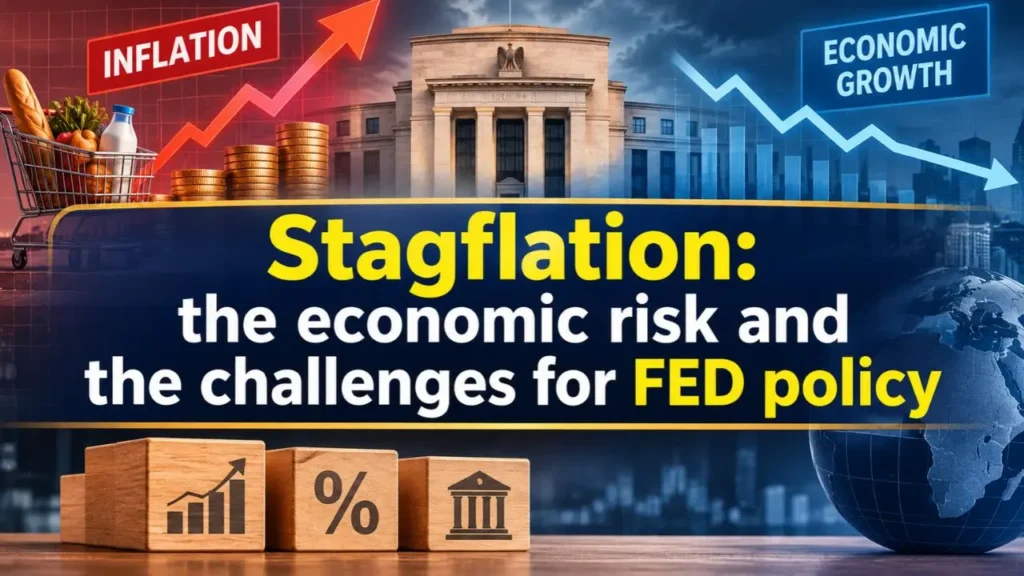
The US economy plays a central role in the functioning of the global economy. Its performance influences financial markets, international trade, investment, and central bank decisions. However, when inflation persists while economic growth slows, monetary authorities face a major dilemma: stagflation.
Therefore, the risk of stagflation constitutes a challenge for American monetary policy, which the US Federal Reserve (Fed) must find a delicate balance between controlling inflation and maintaining economic activity.
I- What is stagflation?
The term stagflation, resulting from the contraction of the words stagnation and inflation, is a macroeconomic phenomenon characterized by the combination of three elements:
- High or persistent inflation;
- Weak, stagnant or even negative economic growth;
- A rise in unemployment.
Unlike a traditional recession, which is often accompanied by a decline in demand and easing price pressures, stagflation has one distinctive feature: the economy slows down while the cost of living continues to rise.
This situation considerably complicates the decisions of central banks, as traditional monetary policy instruments can produce contradictory effects.
Stagflation is particularly worrying because it reduces household purchasing power while limiting job creation opportunities.
1- Why is stagflation difficult to combat?
The difficulty lies in the coexistence of two opposing economic problems.
On the one hand, inflation in principle requires a restrictive monetary policy, characterized by high interest rates.
On the other hand, the economic slowdown often calls for an accommodative monetary policy, designed to facilitate credit and stimulate investment through lower interest rates.
Faced with this, the Fed must therefore avoid two mistakes:
- Reducing interest rates too quickly and allowing inflation to take hold;
- Maintaining excessively high rates will exacerbate the contraction of economic activity.
This dilemma explains why the risk of stagflation represents a major challenge for US monetary policy.
II-What are the main causes of the risk of stagflation?
Stagflation can result from various economic, structural, and geopolitical factors. It often occurs when negative supply shocks combine with macroeconomic imbalances.
1-The rise in energy and raw material prices
Generally, rising prices for oil, gas and other raw materials constitute one of the main sources of stagflationary pressures.
When energy prices rise, businesses face higher production and transportation costs. These increases can then be passed on to the prices of goods and services.
At the same time, households are spending a larger share of their income on energy and essential expenses, which reduces their ability to consume other products.
This mechanism can cause the following simultaneously:
- An increase in production costs;
- An increase in inflation;
- A decrease in purchasing power;
- A slowdown in consumption and investment.
Disruptions to energy supply can fuel US inflation while undermining economic growth; the latest geopolitical conflict in the Middle East is an example illustrating this risk.
2- Supply chain disruptions
International supply chains play a vital role in the production and distribution of goods.
When conflicts, trade restrictions, or logistical difficulties disrupt these chains, businesses can experience supply problems.
These disruptions often lead to:
- Delivery delays;
- An increase in transport costs;
- Raw material shortages;
- A rise in the prices of imported products.
If these difficulties persist, they can cause more sustained inflation while limiting companies’ ability to produce.
3- Trade tensions and tariffs
Protectionist trade policies can also contribute to the risk of stagflation.
The increase in tariffs on imported products raises the costs borne by American companies.
Companies can then choose to pass these costs on to consumers, which fuels inflation.
At the same time, trade tensions can reduce international trade, curb investment and worsen growth prospects.
4- The slowdown in productivity
Productivity represents the ability of an economy to produce more goods and services with a given amount of resources.
When productivity progresses slowly, companies have fewer opportunities to increase their output without increasing their costs.
This situation can contribute to rising prices and a slowdown in potential growth.
The risk of stagflation becomes more significant when low productivity combines with inflationary pressures related to energy, wages or imports.
III- The Federal Reserve’s policy in the face of the risk of stagflation
The US Federal Reserve is responsible for conducting US monetary policy.
Its mandate aims in particular to promote price stability and full employment. These two objectives can become difficult to reconcile when the economy faces a risk of stagflation.
1- The role of interest rates in the fight against inflation
The Fed’s main conventional instrument is the policy interest rate, which influences financing conditions in the economy.
When the Fed raises interest rates, credit generally becomes more expensive for households and businesses.
This development may reduce:
- Consumption financed by credit;
- Business investments;
- Real estate demand;
- Inflationary pressures linked to excessive demand.
However, a rise in interest rates can also slow economic growth and increase unemployment.
The transmission mechanism of monetary policy explains why the Fed must act cautiously. A restrictive policy can help reduce inflation, but its effects on the real economy can be significant.
2- Why can’t the Fed simply lower rates?
A decrease in interest rates can support economic activity by reducing the cost of credit.
It generally encourages households to consume and businesses to invest.
However, when inflation remains high, a premature cut in rates can excessively stimulate demand and increase price pressures.
If households and businesses anticipate a sustained rise in prices, they may adjust their behavior accordingly. Businesses raise their prices, and employees demand pay increases to protect their purchasing power.
This mechanism can make inflation more persistent.
3- Maintaining high interest rates: a risky strategy
When inflationary pressures persist, the Fed may decide to maintain its interest rates at a restrictive level, in order to prevent inflation from becoming entrenched.
However, high rates can also:
- Increase the financing costs for businesses;
- Reduce productive investments;
- Slow down the housing market;
- Increase the risk of financial difficulties;
- Worsen job prospects.
Restrictive monetary policy can therefore help to control inflation, but it also risks exacerbating the economic slowdown.
Conclusion
The risk of stagflation represents a major challenge for the US Federal Reserve, which must adopt a cautious, flexible approach based on evolving economic data.
The combination of persistent inflation and an economic slowdown limits the effectiveness of traditional monetary policy instruments.
However, combating stagflation cannot rely solely on monetary policy. Targeted fiscal policies, productive investments, and structural reforms also play a crucial role.